Dumpster Permit Rules Murfreesboro, TN | Big Dave's
Placing a dumpster in your driveway usually needs no permit. Placing one at the curb or in the street is a different story. Here's how Murfreesboro's right-of-way rules work, plus why Tennessee 811 matters even for a dumpster that never touches the ground with a shovel.
9 min readUpdated 2026-03-22By Big Dave's Dumpster Rental
The single most common question we field before a drop-off isn't about size — it's "do I need a permit for this?" The honest answer is that it depends entirely on where the dumpster sits, not on the fact that it's a dumpster. A container parked on your own driveway is treated very differently than one parked at the curb or in a traffic lane. This guide walks through that distinction for Murfreesboro, Rutherford County, and Tennessee's 811 "call before you dig" rule, so you can plan placement before your rental shows up instead of after a city inspector or a code officer asks about it.
One caveat worth stating plainly: permitting rules and fees can change. What follows is general guidance based on how right-of-way permitting typically works in Tennessee municipalities, plus what Murfreesboro's own city site publishes about its Right-of-Way (ROW) program. For your specific address and timeline, the most reliable answer comes from a phone call to the City of Murfreesboro (or Rutherford County, if you're outside city limits) before delivery day.
Driveway vs. Street: Why It Matters for Your Permit
Almost every dumpster placement question comes down to one line: is the container sitting on private property, or is it sitting on public property?
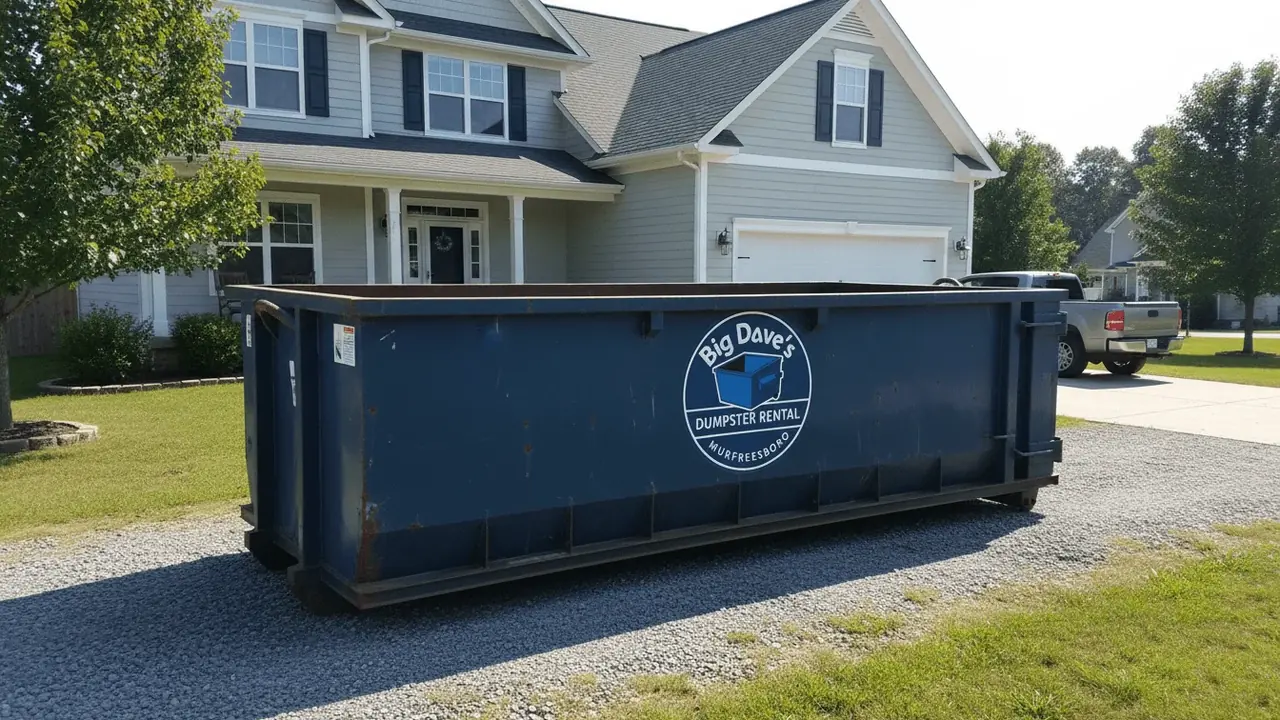
Private property includes your driveway, a parking pad, a side yard, or anywhere else inside your own lot lines. This is the placement that almost never requires a city permit, because the city has no jurisdiction over how you use your own driveway.
Public property includes the street itself, the curb lane, and — importantly — the strip of land between the sidewalk and the curb (or between the sidewalk and the road, if there's no curb). That strip is public right-of-way even though it often looks like part of somebody's yard. Placing anything there, including a dumpster, typically requires the city's permission.
This is why the same 20-yard dumpster can be a non-issue on one job and a permit requirement on the next — it's not about the box, it's about the ground underneath it.
When You Can Usually Skip the Permit: Driveway and Private-Lot Placement
If a dumpster fits entirely on your driveway, in a private parking lot, or elsewhere fully inside your property boundary, you generally do not need a city placement permit in Murfreesboro. That covers the majority of residential cleanouts, roofing tear-offs, and remodel jobs we deliver for. A few practical notes that still apply even without a permit:
The container still needs to sit on a surface that can handle the weight — driveways, aprons, and yard-waste projects on concrete or asphalt are ideal; soft ground, especially after rain, can rut or sink under a loaded 20- or 30-yard box.
Homeowners association (HOA) rules are separate from city permits. Some Murfreesboro-area subdivisions have their own restrictions on how long a dumpster can sit in a driveway or whether it needs to be screened from the street. Check your HOA covenant if you're in a managed community — the city having no permit requirement doesn't override an HOA rule.
Overhanging tree limbs, low utility drops, and narrow driveway approaches can still limit where on your own property a roll-off truck can safely deliver, independent of any permit question.
If you're not sure how much clearance your driveway has for a given box, our dumpster sizing guide and the full size chart cover typical footprints for each size.
When You Likely Need a Permit: Street, Curb, and Right-of-Way Placement
If your driveway is too short, too narrow, blocked by a parked vehicle, or simply unavailable — a tight in-town lot, a downtown storefront renovation, an MTSU-area rental with no off-street parking — the dumpster may need to sit at the curb or partially in the street. That's public right-of-way, and it's where a permit almost always becomes necessary.
The City of Murfreesboro maintains a formal Right-of-Way program, administered through a Right-of-Way Coordinator, that governs construction, obstructions, and placements within the public ROW — the space that includes the street, curb, and the planting strip along many residential streets. The city publishes a dedicated ROW page and a Right-of-Way permit application through its Permit Center. That program exists specifically because anything sitting in or over the public right-of-way — a dumpster, a construction fence, a stack of materials — can affect drainage, sight lines, emergency-vehicle access, and pedestrian safety, all of which the city has a legitimate interest in managing.
What that generally means in practice for a street-placed dumpster:
You (or your contractor) contact the city before delivery to confirm whether a right-of-way or obstruction permit is required for your specific street and placement.
The city may set conditions — reflective markers, cones, or barricades around the container; a maximum number of days it can remain; requirements to keep a travel lane and sidewalk clear.
Fees, surety requirements, and the exact application vary by the scope of what's being placed, so it's worth asking directly rather than assuming a flat number applies to a temporary dumpster the same way it applies to a construction project.
Because specifics vary by address and project, confirm directly with the city rather than relying on secondhand information — including this article. A quick call before delivery day beats a citation or a forced early pickup later.
Placement
Typical permit need
Key things to check
Driveway / private lot
Usually none from the city
Surface strength, HOA rules, overhead clearance
Curb, planting strip, or street
Right-of-way / obstruction permit likely required
Confirm with the city, expect markers/reflectors, possible time limit
Sidewalk (fully or partially blocking)
Permit and/or pedestrian detour likely required
ADA access must generally be maintained or an alternate route provided
County road, unincorporated Rutherford County
Check with Rutherford County (not the city)
Different department, different contact than in-city placements
County Roads Outside City Limits
Not every Big Dave's delivery is inside Murfreesboro's city limits. Rutherford County covers a lot of ground outside the city — Walter Hill, Christiana, Rockvale, and other communities we serve sit on county-maintained roads rather than city streets. If your project is outside the Murfreesboro city limits, the City of Murfreesboro's Right-of-Way Coordinator isn't the right contact — you'd instead be looking at Rutherford County's own road department for anything placed on or beside a county road. The same underlying logic applies: private driveway placement is generally straightforward, while anything extending into the county road's right-of-way is a different conversation with a different office. If you're unsure which jurisdiction your address falls under, our team can usually help point you the right direction when we schedule your delivery — see contact us for details.
Tennessee 811: Call Before You Dig — Even for "Just a Dumpster"
A dumpster permit question and a Tennessee 811 question are two separate things, and it's worth keeping them straight. The right-of-way permit is about whether you're allowed to place a container on public property. Tennessee 811 is about what's buried underneath wherever that container — or any digging, staking, or ground-disturbing work near it — ends up.
Tennessee uses the standard, nationwide 811 "call before you dig" system, operated in-state as Tennessee 811. Under Tennessee law, anyone planning to dig, excavate, move earth, or otherwise disturb the ground — homeowners and contractors alike — is required to notify Tennessee 811 before starting. In practice for most dumpster rentals, that requirement is triggered less by the dumpster itself (which typically just sits on the surface) and more by anything connected to the project around it: fence-post holes, a demolition that disturbs footings, grading work, or driveway/patio removal happening alongside your cleanout.
The mechanics of an 811 request, per Tennessee 811's own published guidance:
Call 811 (or 800-351-1111) at least three working days before you plan to start digging.
Member utilities then have up to 72 hours (excluding weekends and holidays) to locate and mark their underground lines in your work area with paint or flags.
A locate ticket is generally valid for 15 calendar days from the requested start date; if your project runs longer, you're expected to call again at least three working days before the ticket expires to renew it.
811 notifies participating ("member") utilities — it's still worth separately confirming with any non-member utility or private line operator serving your property.
Why bring this up in a dumpster placement article at all? Two practical reasons. First, if your project involves any ground disturbance near where the dumpster will sit — a fence coming out, a mailbox post being reset, a driveway apron being replaced — that's exactly the kind of work 811 covers, and it's a free call that protects you from a damaged gas or electric line. Second, street and right-of-way placements sometimes sit near shallow utility infrastructure (meter boxes, shut-off valves, buried service lines running from the main to a house), so it's simply good practice to know what's under and around a curb-side placement, permit or not.
One more distinction worth being explicit about, because it trips people up who've lived in other regions: Tennessee is not part of the New England Dig Safe System. If you or a contractor moved here from Massachusetts, Connecticut, or another Northeastern state, forget "Dig Safe" — in Tennessee, the number and the name are the same thing: 811, run by Tennessee 811.
Placement Safety Rules That Apply Either Way
Whether your dumpster sits in the driveway or gets a right-of-way permit for the street, a few practical safety habits apply universally:
Keep a clear path for pedestrians, especially near sidewalks and school-adjacent streets.
Don't block a fire hydrant, mailbox access, or a neighbor's driveway approach.
Use reflective tape, cones, or barricades on any container placed where vehicle or foot traffic passes near it at night — required for street placements, and simply smart practice even in a driveway close to the road.
Never overload a container above the fill line; an overloaded box is harder to haul safely and is more likely to draw attention from code enforcement regardless of where it sits.
What Happens If You Place a Dumpster Without a Required Permit
Skipping a required right-of-way permit isn't just a paperwork risk. Depending on the city's response, an unpermitted street placement can result in a citation, a requirement to relocate the container on short notice (sometimes at your cost if it means an extra trip for the rental company), or complaints from neighbors that draw code enforcement attention to the rest of the project too. It's a fairly small amount of friction — one phone call before delivery — to avoid a much bigger headache mid-project. If there's any doubt about whether your placement needs a permit, the safer assumption is to check first.
How Big Dave's Helps You Get Placement Right
When you book with us, we talk through where the dumpster will actually sit — not just what size you need. If your driveway can handle the box, that's usually the simplest path and the one most of our Murfreesboro customers use. If street or right-of-way placement looks likely — a tight lot, a downtown job, a project with no off-street parking — we'll flag that early so you have time to check with the city (or Rutherford County, for jobs outside city limits) before your delivery date instead of scrambling on drop-off morning. We're a call-only business, which keeps this conversation quick: reach us directly at (629) 238-032 and we'll help you figure out the right size and the right spot for it. For general project and disposal questions beyond placement, our FAQ page and our guide to what actually drives dumpster rental cost in Murfreesboro are good next reads.
Whichever placement you end up with, get the permit question settled — and if your project involves any ground disturbance nearby, get your free Tennessee 811 locate request in — before the truck shows up. It's the cheapest insurance policy on the whole job.
Big Dave's Dumpster Rental
Written by the team that runs the trucks out of our yard on 1018-1024 Seals Way in Murfreesboro. We haul
roll-offs across Rutherford County, Cannon County and the wider Murfreesboro area every week. Questions about your own job?
Call (629) 238-032.
Talk to a real person
Ready to book a container in Murfreesboro?
Call and describe the job. Flat price, stated tonnage, and a delivery time on the same call.
Do I need a permit for a dumpster in my own driveway in Murfreesboro?
Generally, no — placing a dumpster entirely on your own driveway or private property is not something the City of Murfreesboro requires a permit for, since it's outside the public right-of-way. Always double-check any HOA rules that might apply separately, and confirm directly with the city if your address or project has any unusual circumstances.
When does a dumpster placement in Murfreesboro require a right-of-way permit?
If the dumpster needs to sit at the curb, on the planting strip, on the sidewalk, or in the street itself, it's on public right-of-way, and the City of Murfreesboro's Right-of-Way program generally applies. The city administers ROW permitting through its Right-of-Way Coordinator and Permit Center — contact them directly before delivery to confirm requirements for your specific street and project.
Is Tennessee 811 the same as Dig Safe?
No. Dig Safe is the regional call-before-you-dig system used in New England (Massachusetts, Connecticut, and neighboring states). Tennessee uses the national 811 system operated in-state as Tennessee 811. If you're working in Murfreesboro or anywhere else in Tennessee, the number to call is simply 811.
Do I need to call 811 just to have a dumpster delivered?
A dumpster that only sits on an existing driveway or paved surface typically isn't digging into anything, so it doesn't automatically trigger an 811 requirement on its own. But if your project involves any ground disturbance nearby — removing a fence, resetting a mailbox post, tearing out a driveway or patio, grading — that work does require an 811 call at least three working days ahead, under Tennessee law, whether you're a homeowner or a contractor.
What if my project is outside Murfreesboro's city limits, in unincorporated Rutherford County?
Placements on private driveways generally follow the same commonsense rules anywhere. But if placement extends onto a county-maintained road's right-of-way, the City of Murfreesboro's ROW Coordinator isn't the correct contact — you'd instead need to check with Rutherford County's road department, since city and county right-of-way are managed separately.
Every May and August, thousands of MTSU students clear out dorms and rental houses across Murfreesboro. Here's how renters, parents, and landlords use a dumpster rental to handle move-out season without the truck-bed shuttle runs.
New subdivisions, commercial pads, and infill projects are reshaping Murfreesboro and Rutherford County as Nashville's growth pushes south along I-24. Here's what that means for contractors planning debris removal, and how to size a roll-off correctly for a new-build job.
Middle Tennessee sees real severe weather, especially in spring. Here's a practical guide to tree debris, structural damage, and sizing a dumpster for storm cleanup in Rutherford County.