Tennessee Debris Disposal Rules | Rutherford County, TN
Tennessee debris disposal rules come from three different layers of government. Here's who regulates what, which items are off-limits in a rental dumpster, and where Rutherford County residents can legally take the rest.
9 min readUpdated 2026-02-12By Big Dave's Dumpster Rental
Renting a dumpster in Rutherford County comes with a short list of rules that are easy to follow once you know them — and expensive to ignore if you don't. Some of those rules come from the State of Tennessee, some come from Rutherford County, and a few come from the City of Murfreesboro. This guide walks through who regulates what, which materials are off-limits in a roll-off dumpster, and where local residents and contractors can legally take the items a dumpster can't hold. As always, verify current details with the agency directly before your project — rules and hours can change, and your Big Dave's crew is happy to double-check anything specific to your job when you book.
Who Actually Regulates Debris Disposal Here
It helps to understand that "debris disposal rules" in Rutherford County actually come from three different layers of government, each with a different job:
The Tennessee Department of Environment & Conservation (TDEC) is the state agency responsible for solid waste policy statewide. Through its Division of Solid Waste Management, TDEC permits and inspects landfills, transfer stations, and construction/demolition (C&D) debris facilities under the Solid Waste Management Act of 1991 (Tenn. Code Ann. § 68-211-101 et seq.). TDEC doesn't run curbside pickup or tell you which bin to use — its job is making sure the facilities that eventually receive Tennessee's waste are permitted, engineered, and operated safely.
Rutherford County operates its own network of solid waste convenience centers and a transfer station, and sets rules for what county residents can drop off and where.
The City of Murfreesboro runs its own municipal garbage, recycling, and bulky-item collection program for city residents, separate from the county system.
When you rent a roll-off dumpster from Big Dave's, we handle the trip to a permitted disposal facility for you. But a small number of materials can't legally go into any dumpster — ours or anyone else's — because state and federal law routes them to a different disposal path entirely. Knowing that list before you start loading saves you a redo, a fee, or worse, a fine.
Items That Cannot Go in a Rental Dumpster
Every reputable dumpster rental company in Middle Tennessee works from roughly the same prohibited-items list, because it's driven by state law and by what permitted landfills and C&D facilities are allowed to accept — not by company preference. Here's what to keep out of your Big Dave's dumpster and, in general terms, why:
Item
Why it's restricted
Tires (any quantity)
Tennessee law bans whole, unshredded tires from landfills outright (Tenn. Code Ann. § 68-211-865). Tires must go to a permitted tire processor or a county tire collection point instead.
Household hazardous waste
Paint thinners, pesticides, pool chemicals, herbicides, automotive fluids, and similar flammable, corrosive, or reactive chemicals are handled through TDEC's dedicated Household Hazardous Waste (HHW) program, not through general solid waste disposal.
Electronics ("e-waste")
TVs, computers, monitors, and similar devices contain lead, cadmium, and other metals the state discourages landfilling. Rutherford County accepts residential e-waste free of charge at select convenience centers instead.
Batteries (household and vehicle)
Lead-acid batteries and rechargeable batteries are recyclable and are kept out of the general waste stream through separate collection.
Refrigerant-bearing appliances
Refrigerators, freezers, and window AC units contain refrigerant that federal law (Clean Air Act Section 608) requires to be professionally recovered before the appliance is scrapped or landfilled.
Wet or liquid paint
Liquid paint is treated as hazardous or special waste in most cases. Fully dried latex paint is often acceptable as regular trash — but check first rather than assuming.
Medical and biohazard waste
Regulated separately for public health reasons; never appropriate for any general dumpster.
Asbestos-containing material
A regulated special waste requiring specific handling, packaging, and a permitted disposal site — call us before you start any demolition where this is a possibility.
Contaminated soil or fuel tanks
Anything suspected of contamination requires special waste approval from TDEC before disposal, not a standard roll-off.
If you're not sure whether something on your job site fits one of these categories, ask before you load it. It's a five-minute phone call to Big Dave's versus a dumpster that gets rejected at the facility, and rejected loads cost time and money either way.
What's Perfectly Fine in a Roll-Off Dumpster
The restricted list looks longer than it is in practice. The overwhelming majority of what actually fills a residential or construction dumpster is completely fine to load, including:
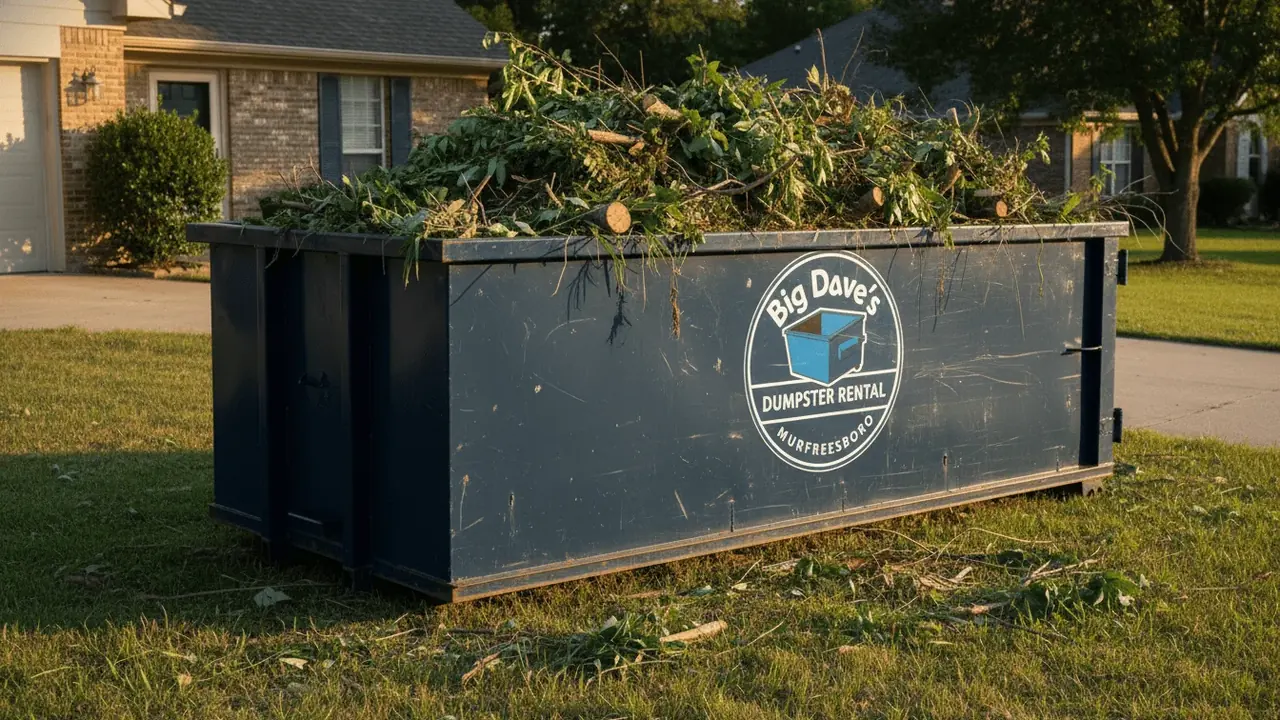
Brush, limbs, and general yard waste (some facilities handle organic debris separately from mixed C&D, which is why we ask about your project type up front)
Cardboard, packaging, and general non-hazardous business waste from a commercial cleanout
When you book with us, we'll confirm your project type and pick the right size from our dumpster size guide so your load matches what the destination facility is actually equipped to process.
Construction & Demolition Debris Gets Its Own Rules
Construction and demolition (C&D) debris — concrete, wood, drywall, roofing, and similar building materials — is regulated by TDEC as its own category of solid waste, separate from household garbage and separate from Class I municipal solid waste landfills. Tennessee permits dedicated C&D disposal facilities specifically for this material, and those facilities have their own acceptance criteria.
In practice, that means a couple of things worth knowing before a bigger renovation, teardown, or new-build project:
Mixed C&D loads are generally fine, but hazardous materials (old paint cans, solvents, treated materials flagged as special waste) still need to be pulled out first.
Heavy materials like concrete, brick, and dirt are dense enough that a dumpster can hit its weight limit long before it looks full — this is a very common surprise for first-time renters, and it's why we talk through the material mix before your roll-off shows up.
Suspected asbestos (common in older Rutherford County homes with popcorn ceilings, older flooring adhesive, or vermiculite insulation) needs to be identified and handled through a licensed abatement contractor before demolition debris goes in any dumpster.
With Rutherford County and the wider Nashville metro area among the fastest-growing parts of Tennessee, new subdivisions, remodels, and commercial buildouts are a daily reality around Murfreesboro — and a predictable stream of legitimate C&D debris that's easy to dispose of correctly when you know the basics above.
Where to Take What a Dumpster Can't Hold
Rutherford County and the City of Murfreesboro both maintain their own drop-off options for the materials listed above. A few starting points, current as of this writing (always confirm hours and current acceptance rules before you make the trip, since these do change):
General household recycling and bulk drop-off — Rutherford County operates several convenience centers around the county, including locations that accept single-stream recycling (paper, plastics #1 and #2, aluminum, tin, and glass) and bulk scrap metal. The county's Solid Waste Department publishes current locations and hours at rutherfordcountytn.gov.
Electronics — Rutherford County accepts residential e-waste (computers, laptops, tablets, phones, game consoles) at no charge at select convenience centers, including the Leanna Convenience Center in Murfreesboro.
Household hazardous waste — TDEC periodically runs mobile Household Hazardous Waste collection events that rotate through Middle Tennessee counties, including Rutherford County, typically in spring and fall. These events accept the flammable, corrosive, and toxic household chemicals that can't go in a dumpster or curbside can.
Tires — Tennessee law requires every county to maintain at least one waste tire collection point. Contact Rutherford County Solid Waste for the current location.
City of Murfreesboro residents — the City runs its own separate solid waste, recycling, and bulky-item collection program through its Solid Waste Department (murfreesborotn.gov), distinct from the county convenience center system. If you're inside city limits, check the city's own schedule rather than assuming county rules apply.
When in doubt, it's always faster to call the county or city department directly — or ask us. We haul in and around Rutherford County every day and generally know the current lay of the land for the projects we serve.
Illegal Dumping Is Not a Shortcut Worth Taking
Tennessee treats illegal dumping as a criminal offense, not just a code violation. Under the state's litter and illegal dumping statutes (Tenn. Code Ann. § 39-14-502 et seq.), dumping waste on public or private property without authorization can carry real fines and, depending on the quantity and material involved, escalate well beyond a simple ticket. Rutherford County has also seen genuine local attention on solid waste capacity and siting in recent years, including public discussion at the County Commission level about future landfill needs — a reminder that where debris legally goes is an active, ongoing local issue, not settled once and forgotten.
The practical upshot for anyone with a pile of debris and a deadline: a legitimately permitted disposal path, whether that's a rented dumpster hauled to a licensed facility or a proper drop-off at a county convenience center, is almost always cheaper than the risk of a citation — and it's the only option that doesn't leave debris as somebody else's problem.
How Big Dave's Keeps Your Project on the Right Side of the Rules
We've been hauling debris in and around Murfreesboro since 2016, and every dumpster we drop is headed to a permitted disposal facility. Part of our job, alongside picking the right size and getting it placed where you need it, is helping you sort out what belongs in the dumpster and what needs a different stop. A few ways we make that easy:
We ask what you're disposing of before delivery, so the dumpster and any weight limits match the actual job — residential cleanout, roofing tear-off, full demolition, or a straightforward junk removal haul.
We'll flag it up front if something you mention (old appliances, a suspected asbestos material, a stack of tires) needs to go somewhere other than the dumpster, before it becomes a problem at drop-off.
Same-day and next-day delivery means you're not tempted to stockpile debris curbside longer than necessary while you wait.
Have a specific material you're not sure about? Check our FAQ page or give us a call before you start loading — it's the fastest way to keep your project moving without a surprise at the disposal facility.
Quick-Reference: Dumpster-Safe vs. Needs a Different Stop
Goes in a rented dumpster
Needs a separate drop-off
Furniture, general household junk
Household hazardous chemicals (paint thinner, pesticides, pool chemicals)
Written by the team that runs the trucks out of our yard on 1018-1024 Seals Way in Murfreesboro. We haul
roll-offs across Rutherford County, Cannon County and the wider Murfreesboro area every week. Questions about your own job?
Call (629) 238-032.
Talk to a real person
Ready to book a container in Murfreesboro?
Call and describe the job. Flat price, stated tonnage, and a delivery time on the same call.
Does TDEC pick up my trash or manage my local dumpster service?
No. The Tennessee Department of Environment & Conservation (TDEC) sets statewide policy and permits landfills, transfer stations, and construction/demolition debris facilities under the Solid Waste Management Act of 1991. Day-to-day collection, convenience centers, and bulky-item pickup are handled locally by Rutherford County and the City of Murfreesboro, not by TDEC directly.
Can I put tires in a rented dumpster in Rutherford County?
No. Tennessee law prohibits whole, unshredded tires from being landfilled anywhere in the state (Tenn. Code Ann. § 68-211-865), so they can't go in a roll-off dumpster. Every Tennessee county, including Rutherford County, is required to maintain at least one tire collection point for residents and businesses.
What happens if I accidentally load a prohibited item?
Tell us before the dumpster is hauled if you realize something shouldn't be in there — it's much easier to pull an item out at your property than to have a load rejected at the disposal facility. If you're ever unsure whether something is allowed, call us before you load it.
Where do Rutherford County residents take household hazardous waste?
Through TDEC's Household Hazardous Waste program, which runs mobile collection events across Middle Tennessee counties, including Rutherford County, generally in spring and fall. These events accept items like paint thinners, pesticides, pool chemicals, and automotive fluids that can't go in general trash or a rental dumpster.
Is illegal dumping actually enforced in Tennessee?
Yes. Illegal dumping is a criminal offense under Tennessee's litter and illegal dumping statutes (Tenn. Code Ann. § 39-14-502 et seq.), with penalties that scale with the quantity and type of material involved. A legally disposed load — through a permitted dumpster rental or a proper county drop-off — is almost always the cheaper and safer route.
Ever wonder what happens after your roll-off gets hauled away? Here's a straight answer on where construction debris, household junk, and recyclables actually end up in Rutherford County — and why the county opened a new transfer station in 2025.
Placing a dumpster in your driveway usually needs no permit. Placing one at the curb or in the street is a different story. Here's how Murfreesboro's right-of-way rules work, plus why Tennessee 811 matters even for a dumpster that never touches the ground with a shovel.
Every May and August, thousands of MTSU students clear out dorms and rental houses across Murfreesboro. Here's how renters, parents, and landlords use a dumpster rental to handle move-out season without the truck-bed shuttle runs.